

How big a problem is it?
Worldwide, back pain is the single leading cause of disability.
| Low Back Pain Type | Estimated Population Average | Population with Pain Average | Prevalence |
| Frequent, Severe Low Back Pain | 145,804,000 | 11,882,000 | 8.18% |
| Low Back Pain Attributed to Work | 145,742,000 | 8,274,000 | 5.25% |
1 in 3 people state that back pain impacts their everyday life.
Worldwide, disability caused by back pain has increased by 54% from 1990 to 2015. This is mainly due to an increase in population as well as aging, with the biggest increases seen in low-income and middle-income countries.
Economics of Back Pain
The most recent estimate is that $86 billion is spent annually on back pain in the U.S. Billion with a “B”
Costs are reduced by 55% when introducing physical therapy prior to more invasive treatment options.
There are 186.7 million days of work lost per year that result in lost productivity, insurance costs, and worker’s compensation. Back pain is one of the most common reasons for missed work.
The direct cost of missed work due to back pain is estimated to be around $20 billion.
Back pain costs the average sufferer just over $2,000 per year. 60% of people with limitations at work cite lower back pain as the cause of their limitations.
What are the Common Causes of Back pain?
MECHANICAL-non serious (80%)
NON MECHANICAL- serious( 20%)
The topic for today will be mechanical back pain.
It’s not always possible to identify the cause of mechanical back pain but it’s rarely anything serious.
Most back pain is what’s known as “non-specific” or “mechanical” (the pain originates from the joints, bones or soft tissues in and around the spine).
This type of back pain:
- tends to get better or worse depending on your position – for example, it may feel better when sitting or lying down
- often feels worse when moving – but it’s not a good idea to avoid moving your back completely, as this can make things worse
- can develop suddenly or gradually
- is sometimes the result of poor posture or lifting something awkwardly, but often happens for no apparent reason
- may be caused by a minor injury such as sprain (pulled ligament) or strain (pulled muscle)
- can be associated with feeling stressed or run down
- will usually start to get better within a few weeks
Common Causes of mechanical back pain
- Muscle strains: One common cause of back pain is muscular strains. This happens when an unexpected force, twist, or pull is applied to one or several of the muscles in the back. As a result, overstretching can occur in the muscle and can cause pain felt in the back.
- Poor posture- slouching
- Arthritis of the joints of the spine (Facetal arthropathy)
- Disc herniation /Degeneration
- Overweight
How can I prevent low back pain?
There are many ways to prevent low back pain. Practicing prevention techniques may also help lessen the severity of your symptoms if you have a lower back injury.
Prevention involves:
- exercising the muscles in your abdomen and back
- losing weight if you’re overweight
- lifting items properly by bending at the knees and lifting with the legs
- maintaining proper posture.https://www.myspineworld.com/6-important-steps-for-you-to-attain-the-best-posture/
You may also want to:
- sleep on a firm surface
- sit on supportive chairs that are at the correct height
- avoid high-heeled shoeshttps://www.myspineworld.com/6-important-steps-for-you-to-attain-the-best-posture/
- quit smoking, if you smoke
Nicotine causes degeneration of spinal discs and also reduces blood flow.
Each diagnosis are treated with different protocols, therefore it is important that you consult a medical professional before beginning any strenuous rehabilitation program.
Low back exercises and flexibility can be the best treatment option for almost all types of back problems as it is likely to help restore balance in the spine.
Low back exercises concentrate on strengthening with the abdominal muscles, to be able to give stabilization of the spine. Rehabilitation programs or preventative rehabilitation programs that focus on strengthening lumbar muscles combined with core stability and proprioception will reduce the risk of low back pain,if exercises are done correctly, and on a regular basis.
The Lumbar/Core Strength and Stability
What is my “core”?
The “core” is comprised of several groups of muscles including the transversus abdominus, multifidus, diaphragm and pelvic floor muscles. These muscles work together to produce maximum stability in the abdominal and lumbar (lower) back region, as well as coordinate the movement of the arms, legs, and spine.

Engaging these muscles is not something that most people do consciously, therefore it is important to learn how to effectively co-contract these muscles while performing these rehabilitation exercises.
Perform the stretching exercises 5 times a week and strengthening 3-4 times a week
Bottom line before you start with these : If any of the exercises causes extra pain , defer the exercises to another session and take it easy. In other words, listen to your body.
STRETCHING EXERCISES
1- Quadriceps Stretch
Using a towel, or band, lie on your stomach, attach the band to affected foot and pull your heel to your butt or you can simply hold your ankle and pull towards your butt. Hold this stretch for 1 min. Repeat 3 times.

2- Hip Flexor Stretch
Kneel with affected knee on the ground, same side arm goes up and back causing pelvis (hips) to shift forward, and back to extend. Hold for 20- 30 seconds. Repeat 3 times.

3- Adductor Stretch
Prop the inside of your ankle up on a table, lean into the side you’re stretching. Hold for 20-30 seconds. Repeat 3 time

4- Hamstring Stretch
Prop the back of your heel up on a table, keep your back straight, and lean forward at the hips. Hold for 20-30 seconds. Repeat 3 times.

5- Dynamic Hamstring Stretch
Lie on your back, reach hands behind your knee, keep knee at 90 degree angle, and kick up until you feel stretch. Repeat 15-20x each side.


6.Glute Stretch
Prop the outside of your ankle up on a table, make sure leg is at 90 degrees, keep your back steady and lean forward at the hips. You can feel the stretch at the butt area. Hold for 20-30 sec. Repeat 3 times.

7.Prayer/Cat/Camel
1.Start on all fours 2.Prayer- Exhale as you sit back onto heels, lower head, tuck chin and reach arms out 3.Cat- Inhale as you arch the back up and hollow out abdominals while head remains tucked 4.Camel- Exhale reach chin towards ceiling. Repeat 5 times


STRENGTHENING EXERCISES (CORE)
1.Supine Abdominal Draw In
Lie on your back on a table or mat, knees up with feet flat on table/ mat; pull the abs in and push your low push your low back t the table/mat. Repeat 20 times.

2.Abdominal Draw In with Knee to Chest
Lie on your back on table or mat, draw one knee to the chest while maintaining the abdominal draw in; do not grab the knee with your hand. Repeat 10-20 times each leg.


3.Abdominal Draw In with Double Knee to Chest
Lie on your back on table or mat, bring both knees to your chest at the same time. Maintain the abdominal draw in throughout the entire exercise. Repeat 10-20 times.

4.Prone Bridging on Elbows
Lie on your stomach on a table or mat with your forearms/elbows on the table/mat; rise up so that you are resting on your forearms and toes; maintain abdominal draw in; your back should be completely straight; hold this position for 15 sec – 1 min. Progress in increments of 15 seconds. Repeat 5-10 times.

5.Side Bridging on Elbow
Lie on your side with your elbow underneath you; rise up so that you are resting one forearm/elbow and foot on same side; hold this position for 15sec – 1min. Progress in increments of 15 seconds. Repeat 5-10 times. Make sure to complete exercise on both sides.

6.Press Ups
Lie on your stomach on table or mat with legs extended and hands palm down just above shoulders; retract shoulder blades down and in towards the midline of your spine; maintaining that position, lift your chest off of the floor; hold for 3-5 seconds keeping the back of the neck long and making sure front hip bones stay in contact with mat during entire movement.. Repeat 10-20 times.


7.Prone Cobra’s
Lie on your stomach on a table or mat with your arms at your side;
lift your head and chest off the table/mat; hold your glutes (buttock muscles) tight and squeeze your shoulder blades together; hold briefly and return to starting position. Repeat 10-20 times.


8.Superman’s
Lie on your stomach on table or mat with arms and legs extended; retract shoulder blades down and in towards the midline of your spine and draw in abdominal muscles; maintaining this position, lift opposite arm and opposite leg; hold for 3-5 seconds and reverse sides. Repeat 10-20 times.

9.Quadruped Opposite arm/leg
In a quadruped position (on all fours); keep head straight with knees bent to 90 degrees. Engage your core to keep back straight during entire exercise and use your hamstrings, glutes, and low back muscles to lift your leg straight while simultaneously lifting opposite arm; Repeat 10 times each side.


10.Supine Butt Lift with Arms at Side
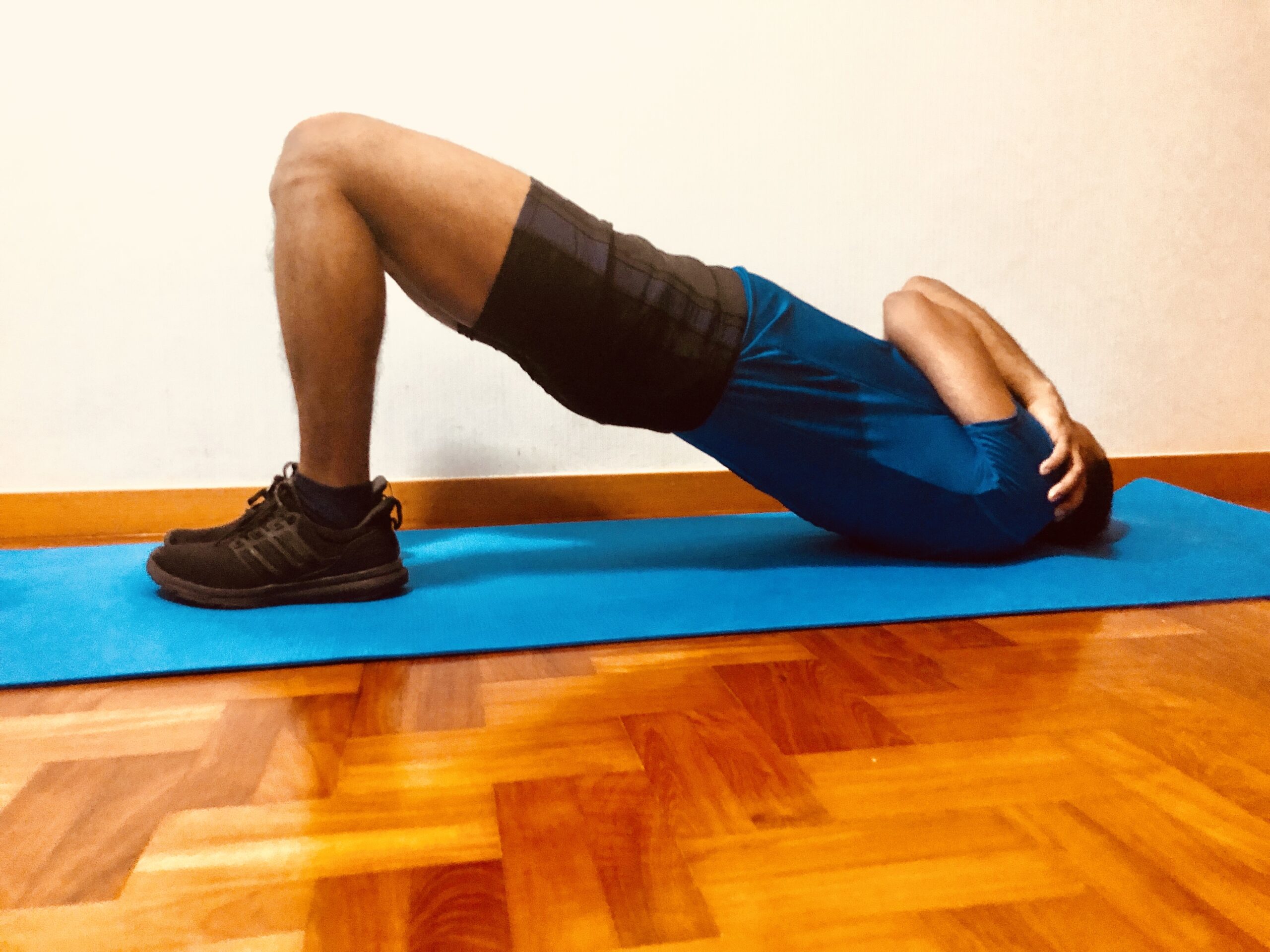
Lie on your back on table or mat with hips and knees bent to 90 degrees with feet flat on floor and arms palm-down at sides; draw in abdominal muscles and maintain throughout exercise; slowly raise your butt off the table/mat by using your glutes and hamstrings until your torso is in line with thighs; hold for 3-5 seconds. Repeat 10 – 20 times.


11.Supine Butt Lift with Arms Across Chest
Lie on your back on table or mat with hips and knees bent to 90 degrees with feet flat on floor and arms across chest; draw in abdominal muscles and maintain throughout exercise; slowly raise your butt off the table/mat by using your glutes and hamstrings until your torso is in line with thighs; hold for 3-5 seconds. Repeat 10 – 20 times.


Do these exercises for a few weeks regularly and you will bounce back to your stronger self.Remember to make these a part of your routine.
See you soon with some more spine tips in My Spine World.Remember, we got your back!
One response to “18 Back Pain Exercises for you to Bounce Back!”
[…] https://www.myspineworld.com/18-back-pain-exercises-for-you-to-bounce-back/ […]