
“Once you choose hope, anything’s possible.”
– Christopher Reeve, Actor and Founder of the Christopher and Dana Reeve Foundation

Spinal cord injury impacts an individual’s physical, psychological, and social well-being and places a substantial financial burden on health care systems worldwide.
While historically spinal cord injury has been associated with very high mortality rates, the work of the American Neurosurgeon Dr Donald Munro at Boston City Hospital in the 1930s, emulated by Sir Ludwig Guttmann at Stoke Mandeville Hospital in the United Kingdom in 1944, saw the beginning of effective treatment and management of spinal cord injury. As a result of 2-hourly turning and skincare, together with better bladder management, the prevailing 80% mortality rate for spinal cord injury began to decline, and improved functional outcomes were achieved with physical and occupational therapy, and more holistic care.
Non-traumatic spinal cord injuries occur as a result of disease, infection and congenital defects with the leading causes being neoplastic tumours and degenerative conditions of the spinal column, followed by vascular and autoimmune disorders.
Traumatic spinal cord injuries most commonly occur as a result of motor vehicle and motor-bike accidents, followed by falls. Sport, in particular, water-based activities and work-related injuries are also common, with a further small but increasing contribution from a gun, knife or war-related injury.
How big a problem is it?
Global incidence shows a huge variance from 8 to 246 cases per million of the population in one study, while further research found similar results with 3.3 to 246 per million, so anywhere from 250,000 to 500,000 new spinal cord injuries annually.

Annual incidence rates also varied significantly between region, ranging from 246 per million in Taiwan, 49.1 per million in New Zealand to just 10.0 per million in Fiji. Similarly, studies available also show a high male-to-female ratio of 5:1 and peak incidence of spinal cord injury occurring at 42 years old, increased from 29 years old in 1970 with a gradual increase in the proportion of non-traumatic spinal cord injury cases, which have been partly attributable to the world’s ageing population.
Patients with spinal cord injuries have had few options for treating their condition as treatments to date have been limited.Today spinal cord injury is preventable; spinal cord injury is survivable; spinal cord injury need not prevent a good quality of life and full contribution to society. This change reflects better medical provisions which means that people are able to survive, live and flourish after injury.
Technology is playing an ever-larger role in SCI therapy and ground breaking research is being done in this field. Let’s look at some of the advances made in this field .
1. Virtual Reality
Virtual reality means an artificial environment which is experienced through sensory stimuli (such as sights and sounds) provided by a computer and in which one’s actions partially determine what happens in the environment.
Up to 50% of patients with paraplegia may still have functional nerve fibres capable of sending faint sensation messages from the lower body to the brain, virtual reality (VR) technology enhances and amplifies those neural signals, in order to restore lower limb sensation.

As studies show, VR and Virtual Reality NeuroTherapy may effectively ‘trick the brain’ into believing that it is physically preforming actions that are being simulated in the VR environment, and can encourage the brain to fire neurological pathways under these circumstances that have otherwise been ‘turned off’ for some time. Virtual Reality is believed to activate the brain’s mirror neurons – neurological pathways responsible for the execution of goal related motor actions.
2. AI(Artificial Intelligence) and Machine Learning
At its simplest form, artificial intelligence is a field, which combines computer science and robust datasets, to enable problem-solving. It also encompasses sub-fields of machine learning and deep learning, which are frequently mentioned in conjunction with artificial intelligence. These disciplines are comprised of AI algorithms which seek to create expert systems which make predictions or classifications based on input data.

Artificial Intelligence (AI) algorithms, are integrated into existing prosthetic limbs , which deploys computer vision and AI to respond to changes in terrain. The program is capable of recognising various key terrain types which may necessitate adjustment of the prosthetic’s movement protocols like brick, concete, glass tiles etc including upstairs and down stairs.
3. Machine learning in gene therapy for gait recovery
An ongoing study based at the École Polytechnique Fédérale de Lausanne in Switzerland has shown promising results in the use of AI and machine learning to identify the neurons which play a key role in the process of gait reacquisition. By singling out the specific neurons which are significant to recovery from spinal cord injury, the researchers have been able to prioritise these neurons for additional stimulation, enhancing the effectiveness of mobility treatments.
4. Stem Cells
Stem cells are blank cells, or undifferentiated cells, which are capable of transforming into specialized cell types. Stem cells are capable of self-renewal, or the ability to multiply while maintaining the ability to develop into other cells.
Stem cell therapies have been studied for some time now. Neurons, however, have a limited ability to regenerate. This has researchers studying how they can effectively use stem cells in the treatment of spinal cord injuries.

Researchers are still trying to understand the precise chemical signals that tell the stem cells what to do in order to create the proper growth and regeneration. Injection of bone marrow-derived stem cells into the cerebrospinal fluid is being studied to see if it will promote the proteins needed to grow nerves and increase nerve signals. Research is limited but is showing promising preclinical results in regenerating neuronal growth and a new connection between neurons.
5. Brain-Computer Interfaces: (BCI)
Brain-computer interfaces bypass nerve cells that have been damaged from a spinal cord injury. These devices, when implanted, may restore control of voluntary muscle movement to paralyzed muscles. Because patients with spinal cord injuries usually have normal brain function, researchers have been able to use the signals sent off by the brain to control a computer-assisted device. Hand and arm orthotics have been used with this device as a way to give hand function back to patients with paralysis.

6. Functional Electrical Stimulation
Promising results are coming from the use of functional electrical stimulation (FES). FES uses a computer and electrodes to give small bursts of electricity to paralyzed muscles. This is done to generate muscle contractions.
Currently, FES is being used to try and restore function that was lost after a spinal cord injury. By stimulating paralyzed muscles, patients are experiencing improvement in hand movements, bladder and bowel control, and even potential for respiration without the use of a ventilator.
In the latest advance , scientists have implanted a pacemaker in the abdomen and electrodes directly onto the spinal cord.
Constructed to be permanent, they are precisely positioned to target all the regions of the spinal cord that are relevant to activate trunk and leg muscles
The electrodes were then paired with new software that facilitated a highly personalized mapping of each patient’s spinal cord which also provides a simple tablet-based interface that allows patients and physical therapists to easily set up semi-automated stimulation programs that enable a variety of movements.

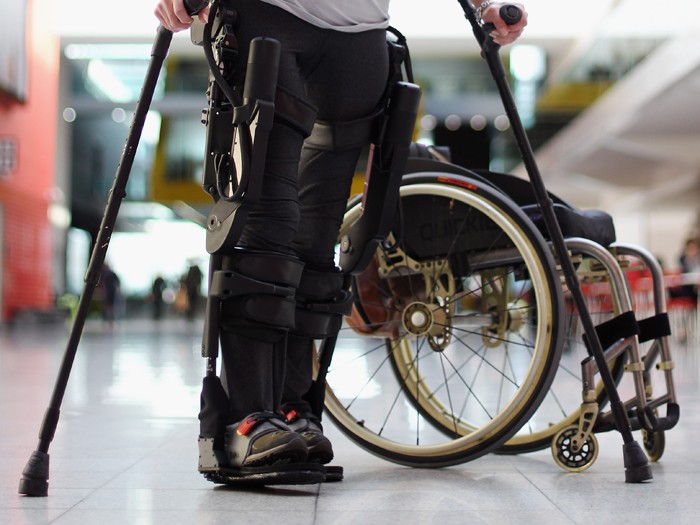
7. Wearable Robots-Exoskeletons..
Robots of all kinds are sweeping the market these days, and they are also seen in the medical field. Researchers have put together a new, exciting, and promising way for paralyzed patients to ambulate. The use of wearable robotic devices is giving patients the ability to walk again.
These “exoskeletons” are rather bulky and heavy, and require assistance to use them. But patients with spinal cord injuries do not seem to mind, given they are able to walk again.
Regular use of robotic exoskeletons may help limit secondary conditions following SCI, including pain, spasticity, and decreased bone mineral density In addition, healthcare providers and home users acknowledge the psychological benefits that exoskeletons provide through eye-level social interactions and increased confidence .Therapists’ use of these devices is still in its infancy relative to user screening, therapy time, and dosage .Studies describe user discomfort, lack of fall mitigation features, and limited utility as major design limitations .The high cost of robotic exoskeletons also limits purchases by most potential users.

Much more research is needed to make the use of exoskeletons safe for the patient, but these robotic devices have a promising future.
Technology will advance further and will have significant breakthroughs. But through all this, the patient with spinal cord injury, will have to adjust and adapt to the new normal.
There is no “one way” to adjust to life after SCI. However, research can offer some insight into what adjusting well looks like. People who adjust well:
- Do not experience depression, or if they are depressed soon after injury, they feel better again within a few weeks.
- Have an effective coping strategy.
- Have a “fighting spirit” and use every means necessary to overcome challenges and setbacks.
- View their injury as a challenge and see the potential for personal growth to make their life better.
- Accept that their injury has happened and decide to live with it.
- Are resilient, meaning they bounce back when they experience difficult times or changes in life.
Some common traits that people who are resilient have.
- Seek purpose and meaning. Think about what you want in life. Is it a job? Family? You can have a job, a family and most anything else that you want in life. The key is to set the goals you want to achieve and relentlessly strive to reach those goals.
- Stay connected with your support network. Your family, friends, faith, and others in your community can be a great resource to help you adjust to life after injury and reach your goals.
- Use resources to make your life better. There are many organizations, agencies and community resources that offer help to people with SCI.
Here I give one such example how positivity helps you bounce back.
See you soon with some more spine tips in My Spine World. Remember, we got your back !