

Sounds bizarre..?? Nothing could be further from the truth!
Let’s go thru some basics about climate change and then analyze how spine surgeons/other surgeons fit into the puzzle.
Climate change and Global warming
Climate change is a long-term change in the average weather patterns that have come to define Earth’s local, regional and global climates. These changes have a broad range of observed effects that are synonymous with the term.
Changes observed in Earth’s climate since the early 20th century are primarily driven by human activities, particularly fossil fuel burning, which increases heat-trapping greenhouse gas levels in Earth’s atmosphere, raising Earth’s average surface temperature. These human-produced temperature increases are commonly referred to as global warming.
Carbon foot print
A carbon footprint is the total amount of greenhouse gases (including carbon dioxide and methane) that are generated by our actions.
https://www.nature.org/en-us/get-involved/how-to-help/carbon-footprint-calculator/
The average carbon footprint for a person in the United States is 16 tons, one of the highest rates in the world. Globally, the average is closer to 4 tons. To have the best chance of avoiding a 2℃ rise in global temperatures, the average global carbon footprint per year needs to drop under 2 tons by 2050.

Scientific evidence for warming of the climate system is unequivocal.
The current warming trend is of particular significance because it is unequivocally the result of human activity since the mid-20th century and proceeding at a rate that is unprecedented over millennia. It is undeniable that human activities have warmed the atmosphere, ocean, and land and that widespread and rapid .
The heat-trapping nature of carbon dioxide and other gases was demonstrated in the mid-19th century. Their ability to affect the transfer of infrared energy through the atmosphere is the scientific basis of many instruments flown by NASA. There is no question that increased levels of greenhouse gases must cause Earth to warm in response.
Evidence reveals that current warming is occurring roughly ten times faster than the average rate of ice-age-recovery warming. Carbon dioxide from human activity is increasing more than 250 times faster than it did from natural sources after the last Ice Age.
The evidence for rapid climate change is compelling:
Global Temperature Rise
The planet’s average surface temperature has risen about 2.12 degrees Fahrenheit (1.18 degrees Celsius) since the late 19th century, a change driven largely by increased carbon dioxide emissions into the atmosphere and other human activities. Most of the warming occurred in the past 40 years, with the seven most recent years being the warmest. The years 2016 and 2020 are tied for the warmest year on record.
Warming Ocean
The ocean has absorbed much of this increased heat, with the top 100 meters (about 328 feet) of ocean showing warming of more than 0.6 degrees Fahrenheit (0.33 degrees Celsius) since 1969. Earth stores 90% of the extra energy in the ocean.
Shrinking Ice Sheets
The Greenland and Antarctic ice sheets have decreased in mass. Data from NASA’s Gravity Recovery and Climate Experiment show Greenland lost an average of 279 billion tons of ice per year between 1993 and 2019, while Antarctica lost about 148 billion tons of ice per year.
Glacial Retreat
Glaciers are retreating almost everywhere around the world — including in the Alps, Himalayas, Andes, Rockies, Alaska, and Africa.
Decreased Snow Cover
Satellite observations reveal that the amount of spring snow cover in the Northern Hemisphere has decreased over the past five decades and the snow is melting earlier.
Sea Level Rise
Global sea level rose about 8 inches (20 centimeters) in the last century. The rate in the last two decades, however, is nearly double that of the last century and accelerating slightly every year.

Declining Arctic Sea Ice
Both the extent and thickness of Arctic sea ice has declined rapidly over the last several decades.
Extreme Events
The number of record high temperature events in the United States has been increasing, while the number of record low temperature events has been decreasing, since 1950. The U.S. has also witnessed increasing numbers of intense rainfall events.

Ocean Acidification
Since the beginning of the Industrial Revolution, the acidity of surface ocean waters has increased by about 30%. This increase is the result of humans emitting more carbon dioxide into the atmosphere and hence more being absorbed into the ocean. The ocean has absorbed between 20% and 30% of total anthropogenic carbon dioxide emissions in recent decades (7.2 to 10.8 billion metric tons per year).
Climate change and Health
Climate change is the single biggest health threat facing humanity, and health professionals worldwide are already responding to the health harms caused by this unfolding crisis.

The Intergovernmental Panel on Climate Change (IPCC) has concluded that to avert catastrophic health impacts and prevent millions of climate change-related deaths, the world must limit temperature rise to 1.5°C. Past emissions have already made a certain level of global temperature rise and other changes to the climate inevitable. Global heating of even 1.5°C is not considered safe, however; every additional tenth of a degree of warming will take a serious toll on people’s lives and health.
The intersection of surgical care and carbon emissions has received little attention. As we try to give more people access to healthcare globally, including surgery, our associated carbon emissions will explode. In the US, the health care system generates 8-10% of all greenhouse gas emissions. (Of note, the largest share of greenhouse gas is transportation, primarily for cars, trucks, ships, trains, and planes…only 1.6% of 2019 new vehicles were hybrid or electric… the Green New Deal encourages more roads and driving).
If the health sector globally were a country, it would be the 5th largest emitter of carbon.
Spine Surgery and climate change
The effects of climate change on surgical patients and the role of spine surgeons/ surgeons in advocating for climate change solutions have not been adequately addressed in the majority of surgical training programs or continuing medical education. For this reason, it is rare to see surgeons involved in sustainability efforts, despite having a trusted voice within the health care system. Surgeons have a critical role to play as leaders for sustainability solutions inside and outside of the OR through research, education and promoting climate-smart health care.
Where does spine surgeon figure in all this mumbo jumbo..?

In the OR ..
Despite having a small physical footprint, ORs make an outsized contribution to a hospital’s climate footprint.
Spine Surgery is very energy-, resource- and waste-intensive, requiring sterilization processes, lighting, cooling and ventilation.
Operating rooms use three to six times more energy than the rest of a hospital, mainly due to the ventilation and temperature control to maintain sterility, even when they’re empty. In some surgical specialties, including spine surgery, single-use plastic devices are employed, instead of reusable metal devices. While reusable devices are generally considered better, the energy source cleaning or manufacturing them may still leave a large greenhouse-gas residue.
The annual carbon footprint of operating rooms may range from about 3218 – 5187 tonnes of CO2 equivalents.

Lowering those tonnes could be beneficial in the fight against climate change.
Wastage and Unused surgical supplies
Another major cost, both environmentally and economically, comes from unused surgical supplies. Especially in spine surgery, the surgeon needs many items available for immediate access if a complication arises. The vast majority of the time the procedure progresses smoothly, so the unused supplies are wasted… just thrown in a landfill. Operating rooms produce 20-30% of a facility’s waste, with 1/3rd being biohazard.

In other circumstances, even reusable equipment like spine screws sets, need to be opened for partial use but then be re-sterilized for future surgeries.

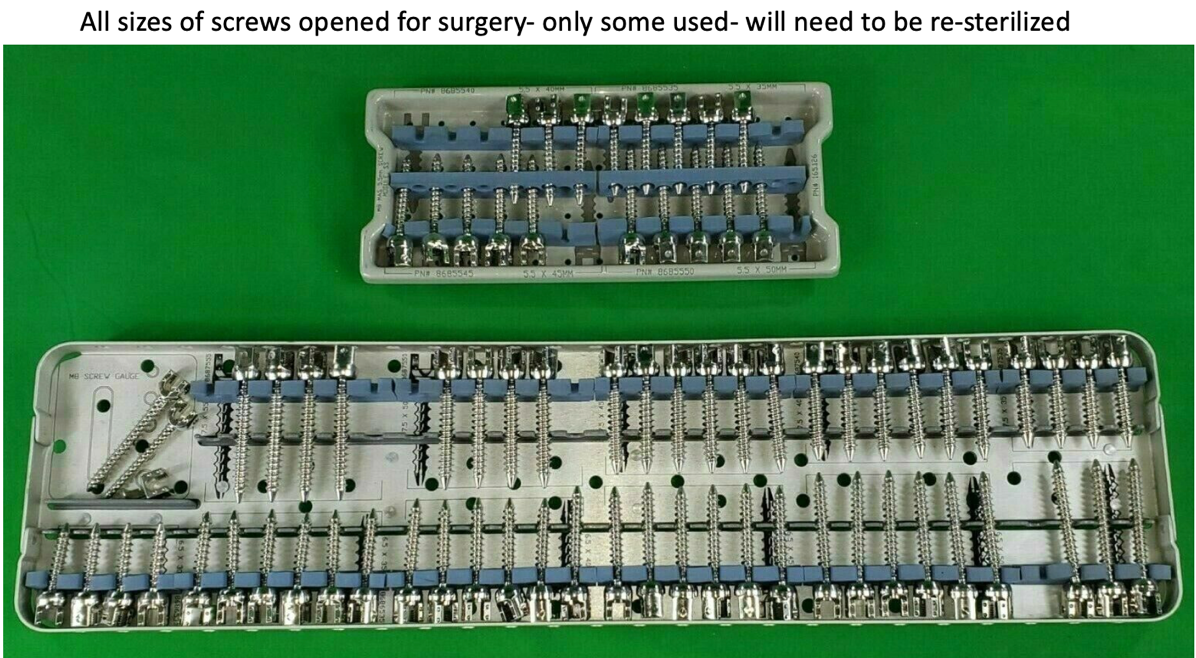

At some institutions performing complex spine surgery, approximately $2.9 million of operating room waste is created annually. Surgery is the most energy- and waste- intensive specialty in health care.
Supply chain
The surgical supply chain is large and expensive, responsible for 40% to 60% of a hospital’s supply chain costs, with recent studies finding that 71% to 82% of health care emissions are derived from the supply chain.

Anaesthetic agents
In addition, volatile anaesthetic gases, particularly desflurane and nitrous oxide, are potent greenhouse gases that can be responsible for 51% of an OR’s greenhouse gas emissions at an average U.S. hospital. The global effect of a single general anaesthetic may be equivalent to releasing ~ 22 kilograms of CO2 into the environment. The worldwide use is about equivalent to the CO2 emissions from 1 million cars !!

How to become a Climate Smart Spine Surgeon?
To mitigate the health sector’s contribution to climate change, we should decarbonise health care. High-income countries contribute the most greenhouse gases and have a responsibility to lead these changes in the health-care sector.
While surgery’s immense environmental impact is often considered necessary to provide high-quality care, studies have shown the impact can be reduced without compromising patient safety or quality.
Recognizing the opportunity to reduce the climate impact of surgical services and reduce costs, many hospitals are taking action and “greening the OR.”
Reprocessing and reusables
Practice Green health estimates that hospitals implementing programs such as single-use device reprocessing and reusable medical products could see median annual savings of $20,060 per OR.

The environmental effect and safety of single-use versus reusable devices will depend on the instrument and the setting. Although reusable devices are often considered better for the environment, in some cases, the greenhouse-gas footprint of single-use devices can be lower, depending on the energy source used to clean or manufacture the reusable equipment.
Single-use devices might be a more appropriate choice in low-resource settings if access is scarce to the infrastructure for decontamination of reusable equipment, which could lead to increased postoperative infections.
Energy efficient OR
To reduce unnecessary energy consumption and minimise carbon footprint, operating rooms can be ventilated on the basis of occupancy.
It is key to oversee and regulate the current sources of energy in operating rooms, switch to more efficient light-emitting diodes, and ensure a transition to renewable power sources. Other strategies that can reduce the environmental harms from operating rooms include preventing non-biohazardous waste from being treated as hazardous, as its management produces more CO2.
Clinical care and coordinated planning
The single largest factor driving health care pollution is clinical care.The choices that spine surgeons and anaesthesiologists make—from device use to selection of an anaesthetic agent to surgical approach—along with minimizing unnecessary surgeries, tests, interventions and medications can help reduce surgery’s impact.
Pre op discussion with the surgical assistants,anesthetists,nurses and vendors about surgical planning will help to reduce unnecessary opening of trays and instruments and keep wastage to the minimum. A programme like Enhanced recovery after surgery (ERAS ) in spine will help to bring in the coordination between various disciplines and help to reduce wastage.

Anaesthetists are positioned to take ownership of a large proportion of the theatre footprint by reducing emissions from volatile agents, whereas HVAC system optimisation falls within the purview of facilities managers and engineers. Surgeons, nurses, perfusionists, and others can influence environmentally preferable purchasing and minimise waste. Much like adoption of ERAS pathways, reducing the environmental impact of surgical services requires a collective drive for cultural change, this time toward a culture of sustainability and social responsibility.
Few tips…
- Starting an OR sustainability committee.
- Working with supply chain and service line leads to eliminate unneeded items in OR kits
- Review preference cards/ lists and products for environmental considerations.
- Request reusable medical devices (patient positioning devices, tourniquets, OR light handles, surgical gowns, drapes, towels, caps).
- Use reprocessed medical devices.
- Use alternative materials to single-use disposable plastic (upcycled bio-based content).
- Reduce traffic inside OR. Reduce assistants when possible.
Outpatient setting
The pandemic has played a significant part in changing health care and for the better. carbon emissions decreased due to lock downs and teleconsultations became common place. In fact these changes are a wakeup call for surgeons to go the green way .
Preop and post op review in outpatient setting and in fact most of the outpatient consultations by teleconsultation whenever possible is another opportunity to reduce the carbon foot print. Everyone saves time and energy.

Research
More research on the carbon footprint of the processes at all levels of surgical and anaesthesia care (from surgical procedures to supply chains) is needed to design effective strategies to reduce emissions.
Life cycle assessment (LCA) is an important tool to quantify health care emissions and allow surgeons to make evidence-based device use and clinical decisions.
As an example, a 2015 LCA study by Thiel et al compared emissions associated with four different surgical approaches—abdominal, vaginal, laparoscopic and robotic—used for hysterectomy. They found that robotic hysterectomy produced the most waste, and using environmentally preferable anaesthesia and reducing anaesthetic gas flow rate could reduce emissions associated with vaginal and abdominal hysterectomy by 65% to 95%. Single-use supplies accounted for the largest share of emissions and recycling did very little to offset these emissions, suggesting single-use items should be avoided or reused when possible. LCA, therefore, provides an understanding of the sources of health care emissions and interventions that can help reduce health care’s footprint. Evaluate how climate affects the health of surgical patients and influences surgery outcomes. Discuss research articles about the climate footprint of surgery in journal clubs.
Education
In parallel to academic efforts to inform best practices, immediate mitigation strategies can be implemented. Integrate education about the intersection of climate change, health and surgery throughout the medical education continuum, including in grand rounds, conferences and departmental talks.
Conferences
The pandemic brought in a sea change to way the conferences were conducted. Most of the conferences have shifted to hybrid mode. Some welcome this some don’t…but the positive impact on the carbon foot print is evident. When surgeons travel less with less food wastage due to less number of physical attendees it indirectly contribute to making spine surgery greener. Conference organisers also should make the conference energy efficient and greener with doing away with plastics and can pressurise the sponsors to go the greener way.

On a personal note
…what can we do as surgeons/ health care professionals to reduce the impact on climate change?

- Fly less, drive less and cycle more
- Move away from high carbon diet to low carbon diet- more plan based diet is healthy and environmental friendly

- Reuse and recycle more
- Use money- divest from fossil fuels and invest in sustainable goods and services
- Talk about it in forums and conferences
1.https://www.thelancet.com/journals/lanplh/article/PIIS2542-5196(20)30247-3/fulltext
All health professionals have a role to play in minimizing the most harmful effects of climate change and health care’s contribution to the climate crisis.
As among the most trusted and respected health professionals, surgeons have many opportunities to leverage their influence and health expertise to advance climate solutions, including climate-smart surgery along with education and research about the intersection of climate change, surgery and the health of patients.
If i was able to make you think about climate smart spine surgery, then its a start! Let’s spread the word. Time is running out!