
By Dr. Rajeesh George
Spine surgery is standing at the edge of a revolution.
Over the last two decades, endoscopic spine surgery has evolved from a niche procedure practiced by a handful of pioneers into one of the fastest-growing fields in modern spinal care.
What was once considered experimental is now increasingly mainstream.
Patients today ask for “keyhole surgery” even before stepping into the consultation room. Surgeons across the world are attending cadaveric workshops, mastering biportal techniques, learning navigation systems, and redefining what minimally invasive surgery truly means. Conferences that once reserved a small corner for endoscopy now dedicate entire halls to advanced endoscopic procedures.
And yet, despite all the progress we have witnessed, the truth is this:
We are probably only at the beginning.
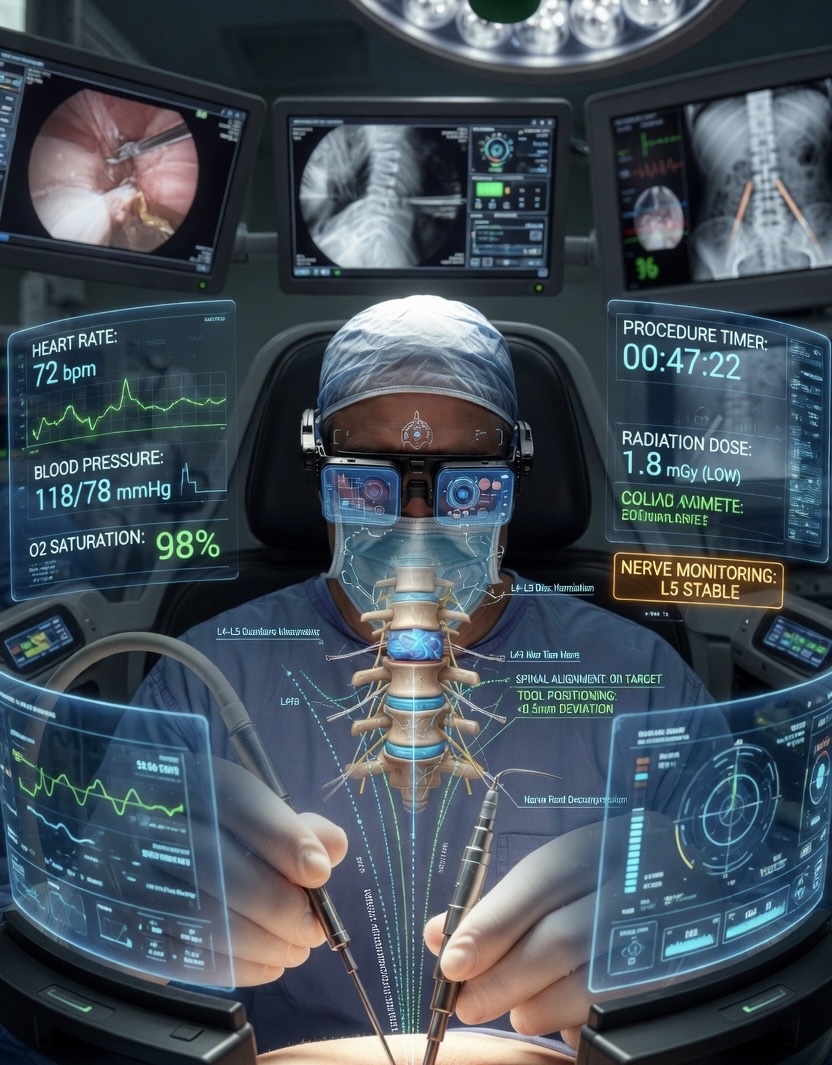
The future of endoscopic spine surgery will not simply be about smaller incisions or better cameras. It will be shaped by artificial intelligence, robotics, augmented reality, navigation, smart instrumentation, biologics, data science, and personalized medicine.
The next decade may fundamentally redefine not only how we operate on the spine, but also how we diagnose, plan, predict, teach, and recover.
The operating room of the future may look very different from the one we know today.

And perhaps more importantly, the spine surgeon of the future may need to think very differently too.
From Mechanical Surgery to Intelligent Surgery
Traditionally, spine surgery has been mechanical in nature.
A compressed nerve was decompressed.
An unstable segment was fused.
A deformity was corrected.
The surgeon relied primarily on:
- Clinical judgment
- Imaging interpretation
- Anatomical knowledge
- Surgical experience
While these fundamentals remain irreplaceable, modern spine surgery is rapidly becoming more data-driven and technology-assisted.
Endoscopic spine surgery sits perfectly at the center of this transformation.

Why?
Because endoscopy already relies heavily on:
- Visualization technology
- Digital imaging
- Precision instrumentation
- Navigation
- Real-time feedback
It is therefore uniquely positioned to integrate seamlessly with the next wave of intelligent surgical systems.
The Evolution of Visualization: Seeing Beyond the Human Eye
One of the greatest strengths of endoscopic surgery has always been visualization.
The magnified view offered by the endoscope allows surgeons to see anatomy with remarkable clarity. Tiny epidural vessels, nerve root sleeves, adhesions, and foraminal structures become vividly apparent under high-definition optics.
But future visualization technologies may go far beyond what current endoscopes offer.

We are entering an era of:
- 4K and 8K ultra-high-definition imaging
- Three-dimensional endoscopy
- Fluorescence-guided surgery
- Augmented reality overlays
- Real-time tissue differentiation
Imagine performing cervical decompression while an augmented reality system projects the patient’s MRI anatomy directly onto the surgical field. Imagine software highlighting the boundaries of the dura, nerve roots, or ossified ligamentum flavum in real time.
The future surgeon may no longer rely solely on visual interpretation.
Technology may actively assist recognition.
This could significantly improve:
- Surgical precision
- Safety margins
- Orientation in difficult anatomy
- Training for younger surgeons
Particularly in complex regions like the cervical and thoracic spine, enhanced visualization may dramatically reduce complications and improve confidence during delicate decompressions.
Artificial Intelligence: The Silent Partner in Spine Surgery
Artificial intelligence is already transforming radiology, diagnostics, and workflow management across healthcare.
Spine surgery will not be exempt.
The future operating room may include AI systems functioning almost like silent co-surgeons.
Not replacing surgeons.
Enhancing them.
AI in Preoperative Planning
Today, surgeons manually evaluate:
- MRI scans
- CT scans
- Alignment parameters
- Disc degeneration
- Foraminal stenosis
- Dynamic instability
In the future, AI systems may instantly analyze thousands of imaging variables and generate:
- Surgical recommendations
- Risk stratification
- Implant sizing suggestions
- Optimal portal trajectories
- Decompression maps
Imagine uploading a lumbar MRI and receiving:
- Automated Schizas grading
- Foraminal classification
- Suggested decompression zones
- Predicted instability risk
- Suitability score for endoscopic surgery
AI may eventually help answer critical questions such as:
- Is decompression alone sufficient?
- Is fusion necessary?
- Which patients are ideal for endoscopic surgery?
- Who is at higher risk of recurrence?
This could dramatically improve patient selection.
And in spine surgery, patient selection is everything.
AI During Surgery
The integration of AI into intraoperative workflows could become one of the most transformative developments in spine surgery.
Future systems may:
- Alert surgeons when instruments approach neural structures
- Detect excessive saline pressure
- Identify incomplete decompression
- Analyze fluoroscopic positioning
- Reduce radiation exposure through automated guidance

Machine learning algorithms trained on thousands of surgical videos may eventually recognize dangerous surgical patterns before complications occur.
The operating room could become smarter, safer, and more predictive.
This is especially relevant in endoscopic surgery where spatial orientation and neural safety are paramount.

AI in Outcome Prediction
Perhaps one of the greatest frustrations in spine surgery is unpredictability.
Two patients with similar MRI findings can have vastly different outcomes.
AI may eventually combine:
- Imaging data
- Clinical symptoms
- Mental health profiles
- Activity levels
- Genetic markers
- Wearable device data
to predict:
- Recovery timelines
- Fusion success rates
- Recurrent disc risk
- Rehabilitation requirements
- Long-term functional outcomes
This may usher in the age of truly personalized spine surgery.

Robotics and Endoscopic Spine Surgery: The Next Frontier
Robotics has already entered spinal instrumentation.
But its marriage with endoscopic surgery is only beginning.
Currently, robotic systems are primarily used for:
- Pedicle screw placement
- Trajectory guidance
- Navigation assistance
However, future robotic systems may assist directly in endoscopic decompression and fusion.
Imagine:
- Robotic arm stabilization of endoscopes
- Tremor elimination during delicate cervical work
- Automated portal alignment
- Precision burr guidance
- Dynamic tracking of instrument movement

Robotic assistance could improve:
- Accuracy
- Ergonomics
- Reproducibility
- Fatigue reduction
This is particularly important because endoscopic spine surgery is physically demanding. Surgeons often operate in constrained positions for prolonged periods.
Future robotic systems may not replace surgical skill, but they may enhance surgical endurance and consistency.
Navigation and Radiation-Free Surgery
One major challenge in spine surgery remains radiation exposure.
Fluoroscopy is heavily used in:
- Portal localization
- Instrument placement
- Endoscopic fusion
- Pedicle screw insertion
Repeated radiation exposure affects both patients and surgical teams.
The future will likely move toward:
- Advanced navigation systems
- Low-radiation imaging
- MRI-based navigation
- Real-time instrument tracking
- Radiation-free workflows

Navigation-integrated UBE may become standard practice.
Surgeons may eventually perform complex decompressions and fusions with minimal or even near-zero fluoroscopy.
This is not merely technological progress.
It is occupational health progress.
Endoscopic Fusion: Where the Battle Will Be Fought
One of the most exciting—and controversial—areas in endoscopic spine surgery is endoscopic fusion.
Currently, many endoscopic procedures focus on decompression.
But increasingly, surgeons are exploring:
- Endoscopic TLIF
- Biportal fusion
- Cage insertion under endoscopic vision
- ENDOLIF techniques
- Facet-preserving stabilization methods
The challenge lies in balancing:
- Adequate decompression
- Stability
- Minimal tissue disruption
The future may include:
- Expandable cages designed specifically for endoscopy
- Smart implants with integrated sensors
- Biologic-enhanced fusion materials
- Navigation-guided cage positioning
- AI-assisted implant selection

Motion Preservation Instead of Fusion?
Another major shift in spine surgery philosophy may involve moving away from fusion whenever possible.
Historically, fusion became the answer for instability, degeneration, and deformity.
But fusion alters biomechanics and can accelerate adjacent segment disease.
Future technologies may increasingly prioritize:
- Motion preservation
- Dynamic stabilization
- Facet preservation
- Disc regeneration
- Biologic repair
Endoscopic surgery naturally complements this philosophy because it emphasizes tissue preservation.
Instead of removing anatomy extensively, surgeons increasingly aim to preserve:
- Muscles
- Facet joints
- Ligaments
- Motion segments
The future may not simply ask:
“How do we fuse better?”
It may ask:
“How do we preserve function longer?”
Biologics and Regenerative Spine Medicine
Perhaps the most fascinating future development is not surgical at all.
What if we could regenerate spinal structures instead of operating on them?
Research is rapidly evolving in:
- Stem cell therapies
- Disc regeneration
- Growth factor injections
- Tissue engineering
- Gene therapy

Although current evidence remains limited and many treatments are still experimental, the future may eventually allow:
- Early disc degeneration reversal
- Biological annular repair
- Cartilage regeneration
- Prevention of adjacent segment degeneration
If successful, regenerative medicine could dramatically change the indications for surgery itself.
Endoscopic surgery may then become part of a hybrid strategy:
- Biological repair plus minimally invasive decompression
- Precision intervention combined with regenerative support
The Rise of Smart Operating Rooms
The operating room of the future may become an integrated digital ecosystem.
Instead of isolated devices, systems may communicate seamlessly:
- Endoscope
- Navigation
- AI software
- Robotic systems
- Patient monitoring
- Imaging platforms
The surgeon may receive real-time analytics on:
- Instrument location
- Irrigation pressure
- Blood loss
- Neuromonitoring trends
- Decompression completeness
Surgery may become increasingly measurable.

This could improve:
- Standardization
- Safety
- Training
- Research quality
Training the Next Generation: A New Kind of Spine Surgeon
The future spine surgeon may need an entirely different skill set.
Traditionally, spine surgery training focused heavily on:
- Anatomy
- Open surgical techniques
- Instrumentation
- Decision-making
Future surgeons may additionally require expertise in:
- Navigation systems
- Digital imaging
- Robotics
- Data interpretation
- AI integration
- Simulation technology
Cadaveric labs may increasingly be supplemented by:
- Virtual reality simulators
- AI-guided training modules
- Augmented reality anatomy systems
- Remote mentoring platforms
A surgeon in Singapore may someday mentor a trainee in Africa or South America in real time through immersive surgical platforms.
Education itself is evolving.
The Human Element Will Always Matter
As AI, robotics, and digital systems advance, one fear often emerges:
Will surgery become impersonal?
The answer should be no.
Because spine surgery is not merely about anatomy.
It is about people:
- The elderly patient afraid of losing independence
- The young athlete desperate to return to sport
- The parent unable to carry a child because of pain
- The worker terrified of losing employment
No AI system can fully understand human suffering.
No robot can replace empathy.
No algorithm can substitute trust.
Technology should enhance humanity in medicine, not diminish it.

The surgeon of the future must therefore become both:
- Technologically advanced
- Deeply human
That balance may define the best spine surgeons of the next generation.
So, Where Do We Go From Here?
The future of endoscopic spine surgery is incredibly exciting.
We are moving toward:
- Smaller incisions
- Smarter surgeries
- Personalized treatment
- Motion preservation
- AI-assisted decision-making
- Robotics integration
- Enhanced visualization
- Faster recovery
- Better patient experiences
But perhaps the most important shift is philosophical.
Spine surgery is gradually transitioning:
- From aggressive exposure to precision preservation
- From mechanical correction to intelligent intervention
- From surgeon-centered procedures to patient-centered recovery
Endoscopic spine surgery represents more than a technique.
It represents a mindset.
A mindset that values:
- Precision over destruction
- Preservation over disruption
- Function over appearance
- Recovery over hospitalization
The future will undoubtedly bring technologies we cannot yet fully imagine.
But regardless of how advanced surgery becomes, one principle must remain constant:
The goal is not simply to operate through smaller holes.
The goal is to improve human lives with greater wisdom, safety, and compassion.
And that may ultimately be the true future of spine surgery.